Se afișează postările cu eticheta Romania highlights. Afișați toate postările

duminică, 27 ianuarie 2013

Epic winter highlights in Romania


As a nature freak and wine afficionado, I must confess: I like winter indeed, no matter how many snow falls or how cold is! The winter has a secret charm, and I can feel it for sure. But of course I am not the only one, and I won't keep for myself.

As a child, I can remember my regular winter works: while visiting my grandma in vacations, in a plain village with harsh winter, I was supposed to shorten and then chop the fire wood. It was a very honorable occupation, and I was very happy doing it. 20 years later was closed to be frozen to death in the same harsh plain, watching over a truck with trading wares which ran out of gas.

Nevertheless, I don't hate and i don't fear winter, but on the contrary, I love it,and allow me to suggest now some winter activities for you as a tourist. There are many winter highlights in Romania, and I must select something special for you.
Skiing in Paltinis, the highest winter resort in Romania

The first saving idea shall be, as you can imagine, ski and other winter sports. there are good ski destinations in Romania, starting with the well renowned, but expensive Poiana Brasov. If you go to Borsa is much cheaper, but the slopes are much easier, good only for beginners. Ranca and Paltinis other important ski destinations in Romania.Right time to inform about the last massive snow falls in Romania, making all the ski destinations to be very good prepared for their guests.
Constanta and the sea in winter have a special secret spell and charm

Another proposition: the sea. Maybe seems weird, but the sea in winter looks fabulous, much more romantic than in summer season with their crowds and mass tourism. The chances to find snow in Constanta or Mangalia are very slim. Not all the hotels are opened in winter, but Hotel Malibu from Mamaia is one of them. Unfortunately no swimming pool inside, you must drive to hotel Yaki, e.g. The amazing city of Constanta looks charming, and in many restaurants, as one of the few visitors, you will be treated much better than in the peak season! They will totally spoil you. Use the opportunity to visit the excellent History museum ( as any contemporary History museum from Romania, it is closed on Monday and the known history stops suddenly with WWII)

If you followed in the hot season a certain way or destination in Romania, please repeat it in winter. It has a newer charm, and thus you are also able to gain another perspective. Such a destination is the Bucharest's Village Museum. Visit this amazing museum, observe the old genuine houses and imagine how was the daily life 200 years ago during course winters. It is the best method to get cured about the winter depression.

Another favorite destination in Romania in winter, or in summer is Sighisoara with its unique Medieval fortress, the only one still inhabitated in the all Europe. Discover it, and other secret charms of this small town staying in the exquisite Hotel Binder Bubi. After a long exhausting walk in the hilly fortress you may be spoiled with a perfect dinner and a sauna, making your day perfect.

So, if you fear the winter depression or winter blue, I have the right cure. As the right medication for many other diseases. Please be and remain positive, and don't worry for anything. Life is good and nice everywhere, but specially in Romania.

marți, 20 noiembrie 2012

Prahova Valley, a Romanian Royal getaway


If you need to relax and detox, if you need to forget the usual trouble and the daily routine, I have the right medicine for you. I really recommend to go from Bucharest to Brasov, through Ploiesti on the A1 highway, along the spectacular Prahova Valley. But please keep in mind, that this highway is the busiest in Romania, and you must avoid it during the week end rush hours, e.g. Friday and Sunday afternoon.

The Prahova is simply superb,  meanders through Bucegi and Baiului Mountains, and could be named The Royal Valley of Romania, because the former King Carol I used to live here, in Sinaia, where he managed to build the fantastic Peles Castle from stone, wood and precious materials. Consequently, all his suite adopted Sinaia as a summer Capital. Ever since that period, the beginning of XXth century, the skiers and mountain climbers are the masters of these places.
Valea Prahovei is simply superb, the best place to disconnect from anything else.

Due to its proximity to Bucharest, Prahova Valley was an important connection between Wallachia and Transilvania., centuries before opening of a railway and a highway in 1880. Because the old highway is obsolete and overcrowded sometimes, there are plans for building a speed highway between Bucharest and Budapest, but the environmental price will be huge ( nowadays in the big forests of the area you can still find bears, wolves and lynxes). The legendary stylish train Orient Express drove this way on his long journey between Paris and Istanbul.
Peles Castle in Sinaia is a must see for any art freak

On the way to the mountains, discover first the quiet town of Campina, where you can find two interesting museums. One of them refers to Nicolae Grigorescu, the most important Romanian painter from all times, which lived here during its last years of life, and left his last masterpiece unaccomplished. He started his career by painting churches and monasteries, and finally an important politician, impressed by his paintings, offered him a scholarship in Paris. Nowadays, if you have the chance to buy a painting of grigorescu, please don't hesitate, it is a safer placement than gold! The secon interesting museum in Campina is Hasdeu Memorial Museum, with a very strange spiritual atmosphere, as Hasdeu, an important political and cultural personality, tried to further communicate with his beloved genial daughter Julia, died at 18 years.

Further, you reach the town of Breaza, which is simply very long, build mainly along the street, and very famous due to its excellent golf coarse. Afterwards, within minutes, you are in Sinaia, and you don't need to hurry up anymore. Enjoy Sinaia in all its splendor, it deserves. The quiet town is very animated on week ends, but in the rest of time keeps an interesting flair of the beginning of XXth Century. After King Carol set here his summer residence emmerged many luxury villas, his suite visited the Casino, and took part to hunting. If you are an art freak, don't miss the Peles Castle, it is simply superb. It was an avangarde building for Romania of those times, heated and electrified. Observe please the wood works, while going from the honor room in the weapon and Marocco room! Next to it, the Pelisor Castle, a paradise for Art Nouveau freaks.

Go deep in the Mountains by the cabin, if you are in the mood to climb them.  Further, before reaching Brasov, find Busteni and Predeal, very important for addicted skiers.

duminică, 21 octombrie 2012

A Romanian Wine Festival


Focsani is a little town 200 km away from Bucharest. Nice, peaceful, clean enough, but has not very spectacular old architecture landmarks, as do  other bigger or smaller cities in Romania. During Ceausescu's forced industrialization policy, all Downtown has been destroyed, and instead have been build so many identical blocks of flats. Maybe it is easier to live in these match boxes, but the city itself acts grey and is not able to differentiate comparing to other sad grey towns countrywide.
In the very peaceful like Focsani, the Wine Festival is a necesary celebration, which everyone waits  in the Autumn

Nevertheless, there are also some things making Focsani special. First of all, in the Vrancea mountains, not far from Focsani (80 km) have the origin and epicenter all the major earthquakes who scares all the Romanians every 50 years. Amazingly, these earthquake don't do much harm in Focsani, but can cause large scale destructions in Bucharest and other towns lieing 200 km away or more! One might say, the people of Focsani are the most feared Romaniawide!
At the presentation stand of vineyard Rovinex I managed to taste an excellent Feteasca Neagra from 2006

Second, Focsani is a local center of the biggest vineyards in all Romania. Consequently, it is normal to organize here an yearly Wine Festival, and this edition from 2012 has a huge budget, which is not so normal in a poor country like Romania. But the people live their lives and take profit from this huge festival with consistent budget. Most important than everything else, the wine is being honored as it deserves, and many exquisite wine tastings ruled by leading someliers took place between 19th-21st of October 2012.
The Romanian "mici" or "mititei" are one of the stars of the Wine Festival. They enjoy a good tradition and reputation, and are easy to pair practically with any wine.

My personal favorite was a fabulous Feteasca Neagra 2006 from Rovinex, which has such a strong bouquet.  Legends say, that you can get drunk with Feteasca Neagra even without drinking a single drop! That impossible to describe bouquet is all the secret! Further, when you have this wine in your mouth you'll notice! Tastes like dried wood fruits, and it is not wise to hold it in the mouth longer than 60 seconds, or you can get drunk again only through tongue absorbtion. Last, you must spit this excellent dangerous wine, no matter how sorry you might be. Pair this wine with a roasted meat or chicken, may be even with mititei, the local star of the Festival and uncrowned King.
Imagine how difficult is for the poor locals to drink the contents of so many barels, paired with mici or  meat.

May be next year you will have the time to see Festival alive, if you will go healthy and wealthy through the End of The World. You need only some time and a small budget, as I have as always some unbeatable propositions, need only to mail at dorugiu@gmx.net or to call at 0726268717

vineri, 12 octombrie 2012

Iasi, the Cultural capital of Romania


The city of Iasi ( also referred as Jassy) is very important for the history of Romania, and every Romanian loves it unconditionally. Nowadays is the country's fourth most populuos city, after Bucharest, Constanta and Cluj-Napoca.
In many parts of the city, the history is very obvious. The House of Dosoftei, a Romanian writer, is 400 years old.

Iasi tries hardly not to live in the past, but in the present, which seems to be very difficult with such a long glorious history and so many old houses and monuments. Iasi is still today the most important economic hub for Moldavia, enjoying simultaneously a rich long history, as I said already.
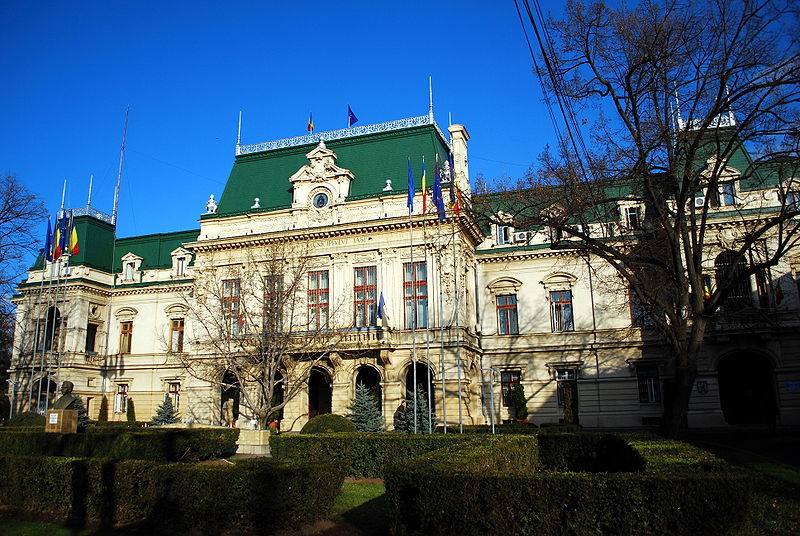
The Iasi City Hall is old, monumental and impressive ( former Palace Roznovanu)

Coming from any direction you will admire the wonderful position of the city from far away. Iasi lies on 7 hills, similar to Rome, and the nicest, or most important is Copou , hosting the city's neighborhood with the same name. Traces of human beings in this wonderful area date back from the paleolithic in the VIth century b.C. (Cucuteni culture for the Archaeology freaks). Not very far, on these blessed hills there are vineyards for sure, in Bucium and Cotnari, and you can take part to wine tasting in those areas. Or you can further taste the best Romanian wines in one of the Iasi many leading restaurants (with a special mention for the Hotel Restaurant Traian, first opened in 1882).
Hotel and restaurant Traian from Iasi is the city's oldest and best

For centuries, during the Middle Age, Iasi has been the Capital of Moldavia, one of the three Romanian countries. After Unification with Vallachia in 1859, the new formed Romania had two Capitals, Iasi and Bucharest, which was amazing, and even overwhelming. Finally, in 1862, Bucharest has been nominated as c
Capital, and Iasi lost its supremacy. But not the importance, to be sure! Between 1916-1918, during WWI, because foreign occupation of Bucharest, Iasi enjoyed again its status of Capital!
The Culture Palace of Iasi is definitely a must do for your schedule in Iasi

The people of and the way of life in Iasi is not so crazing speedy like in Bucharest. The people still have time enjoying free afternoons in a restaurant and taste a glass of wine ( or even beer, if too hot)! The high schools of Iasi still have an excellent level, and the Computer school gave many people to Microsoft.

There are many things to do in Iasi: walking in the Copou Garden crossing the pairs of lovers (most of them are students); visiting the huge Culture Palace, which hosts four Museums; having a good meal or a  wine tasting. You may love Iasi, or hate Iasi, but simply visit it while in Romania. Be sure, I have some special offers for you.


joi, 11 octombrie 2012

Constanta, the Capital of the Romanian seaside


Nowadays in Romania the most important city is by far Bucharest, but for the second place there is a permanent fight among cities like Cluj-Napoca, Iasi or Constanta.
The Casino from Constanta acts a little sad, his founder build it 100 years ago to the memory of his beloved wife.

Constanta has good chances in this undeclared war. In summer, for instance, turns Constanta clearly to be the most important city in Romania, even many people from  Bucharest come here. The city of Constanta enjoys also the title of the oldest city in Romania, being created by Greek colonists already in the VIth century b.C.  In the first century b.C Constanta became for the first time very well known through banning of the Roman poet Ovid in the city, due its irreverent behavior. Ovid left the rest of his life here, being very unhappy  because of the chilly winters and the rudeness of the locals.
The statue is Ovid's, the famous Roman poet, banned to Constanta. Further behind, the history Museum, one of Romania's best

Nowadays, after a trembled milennary history, the things changed and improved dramatically, and I am sure that Ovid, as any other people would like to be banned here, in the uncrowned touristic Capital of the today Romania! The many stylish restaurants of the city never offer (noblesse oblige) chilled wine, but only to the right serving temperature.

From the many hotels of Constanta, I would like to recommend Hotel Yaki from Mamaia, having all the necessary ammenities (Mamaia is a holiday resort, counting as an outskirt from Constanta). Constanta's most important travel agent is his Mayor, Radu Mazare, a controversial picturesque figure, holding the first page of the tabloids!
Constanta means a lot, but first of all sun,sea and beaches.

You have no time for boring in Constanta! First of all, you can take a walk in the Center, in the Ovid square. Behind the statue of Ovidiu there is the Museum of History and Archaeology, one of the Romania's best, due to the richness of the artefacts and the presentation manner. Amazingly, everything stops in 1947, very similar with other leading History Museums from Romania. Not far you can find the Mosque Carol I, the core of the Muslim community of Romania. You can enter for a small fee, and admire a breathtaking panorama of Constanta from the height of its tower. Further the magnificent Orthodox Cathedral of St Peter and Paul, build in 1880, and painted much later in 1950.

Afterwards, walk further on the pier, watching Romania's most important shipyards and ports. And once, very majestic, appears the Casino, one of Constanta landmarks. It acts a little sad, its founder build it for the memory of his beloved wife, who died suddenly.Something very funny for the educated travelers, which is my personal remember: doing this tour of Constanta a few years ago with a super bus, the WC tank gone out of order and should have been evacuated in the very center of Constanta!

Further, whether on Constanta beaches, or in Mamaia, you can take sun bathes, or to have trips for wine tasting in Murfatlar or Niculitel ,  ship tour in Danube Delta. There are so many many things to do in Constanta, really a wide selection to your disposal.

marți, 9 octombrie 2012

Must see in Romania: Sibiu


Maybe not the biggest, but one of the nicest and most important cities not only in Romania, but in the all Europe, Sibiu was elected 2007 (together with Luxemburg) the European Cultural Capital, thus becoming even more popular as a tourist destination
Panoramic view of Downtown Sibiu; far behind, the peak Moldoveanu, Romanian highest, a favorite target for the trekkers

Sibiu has a rich history. It lies on Cibin River, and the Roman fortress in the area was called Castrum Cibinensis, but the first human settlements go back to the Halstatt age. In the XIIth century Sibiu (German Hermannstadt, Hungarian Nagyszeben) appears for the first time in a written document. After a massive German colonisation promoted by the Hungarians, Sibiu became a flourishing city, with 19 guilds, everyone of it having its own tower (not all preserved up to today). The German architecture is still present in the Downtown (divided in Upper Town and the literally Downtown), you will feel transported in Middle Age, somewhere in Germania or Austria!
The City Hall of Sibiu and the Bruckental Museum

The numerous German population was a majority, observed already to the first census after Reunification with Romania, from 1918. But during the WWII the German population decreased, and nowadays only counts 3 % of the total population. In the Ceausescu time, the communist regime promoted the Emmigration, the Germans were the best ware for Ceausescu export. Today, the Romanian population deeply regrets the lacking of germans and warmly welcomes they back. Amazingly, the Mayor of Sibiu is the repesentative of this minority ( Klaus Johannis is very beloved, competent, and was reelected more times).
Group of Norwegian tourists and guide Kjell Hagbarts in Downtown Sibiu

Due to its status as European Capital of Culture, Sibiu experienced a boom in building sector. Toghether with the German investments, results in a very prosperous city. Really a place to visit, and even one to live (according Forbes!). Don't miss Sibiu while in Romania!
Crama Sibiul vechi offers traditional Romanian meals

There is no time to boring in Sibiu, there are so many things to do. Walk in the Centre, from Piata Mica through Piata Huet to Piata Mare, observe the wonderful City Hall, fresh redecorated, of course. If you are an art  and culture freak, don't miss the Bruckenthal Museum, near City Hall. Walk further, near Hotel Imparatul Romanilor, the city's most atractive place to spend the night(s). Further, on Nicolae Balcescu Street, you find a lot of cafes and fancy boutiques, it is the city's most chic and expensive one. And if you are tired, I can recommend a Romanian restaurant checked by myself, with a group of Norwegian tourists, Crama Sibiul Vechi, offering traditional menu, while the waiters wear traditional suit!

If you have more time to spend in Sibiu, visit also the Museum Astra of rural civilization. If you are lucky enough, you will meet couples wedding in the church, or other folkloric festivals.

miercuri, 3 octombrie 2012

City breaks in Romania: Oradea


Very proud of itself, Oradea (Nagyvarad in Hungarian, Grosswardein in German) waits unpatiently and very happy his guests.
Oradea, the River Crisul Repede and the Downtown

You can reach Oradea coming from Hungary, through the charming puszta, or from Arad, but I can propose you a much better and more picturesque way. Namely, come from Cluj Napoca, cross the mountains, and don't miss the source of the River Crisul Repede. Further, to west, after the mountains come the hills, and very soon after the hills also end and the plain starts, you can see the majestic Oradea. The city emerges in the plain, and acts very confident and even very relaxing when coming from this direction! Really hard to explain this strange feeling, I please other visitors, or even locals, to tell me if they experienced the same feeling when entering Oradea. Very amazing for me, I always felt in Oradea excellent, like at home.
The interesting Synagogue from Oradea. Unfortunatelly, through massive deportation during WWII, the Jewish minority almost perished

Oradea is divided in tho halves by the River Crisul Repede. Inhabited from the antique by the Dacs and Romans (her Latin name is Varadinum), it is for the first time mentioned in the XIth century, and completely destroyed by the Mongol invasion of 1241. Rebuild, has gained in prosperity and local importance. The Turks also ruled the city between 1660-1692, followed by Hungarians, and Austrian Habsburg. In 1918 Oradea became part of Romania, which it enjoys up today, almost 100 years ago. Shortly, during WWII, Hitler gave North Transilvania (including Oradea) to Hungary, which ment a condamnation for the strong Jewish minority of Oradea (in 1944 about 25000 Jewish have been deported to the concentration camps! Today there is no more a jewish minority in Oradea, unfortunately).
Oradea, the River Crisul Repede, and the Hotel Continental Forum, the city's best and biggest.

Today, the Hungarian population of Oradea is about a quarter of the total, and sometimes appear again tensions between these people, set up mainly by silly extremists existing on both sides. Nevertheless, Oradea is a very peaceful city, with many mixed marriages and bilingv children, but living at high speed.

There is an old city in Oradea (baroc style from the end of XIXth century), and also a Medieval citadel. Look for History Museum (former Bishop residence), City Hall, Catholic Cathedral, The Black Eagle Palace. Walk in the Downtown and enjoy the people, the city, the weather, everything. Nice city, wonderful life.. Not far, in Felix, you can find thermal baths and follow longer or shorter  treatments, according to needs and budgets. I wish you not to use this opportunity, but keep in mind, who knows!

Some good words about my personel experiences in Oradea hotels. First, I met a Norwegian group on behalf of Karpaten Tourism, who was lead by Kjell Hagbarts and drove by Oivind, at Ramada Hotel. Gyury, Restaurant manager, cooked miraculously within minutes, a refreshing meal for my hungry tired tourists. Btw, he is Hungarian, speaks Romanian, and I have the honor to be among his friends ever since. And another experience, with a Swiss group, staying in Hotel Continental Forum, the city's biggest and best! Which honored allright his **** with the only mention, that the room cards lost easily their magnetic field!

Really a nice city, worths a visit. Contact me for any possible question about Oradea, feel free to do it.

duminică, 30 septembrie 2012

Myths, legends and facts about Dracula


Bram Stoker's book "Dracula" is purely fiction, nevertheless based on some historical truths. Personally, I was first shocked and hurt by the book, and its references, but nowadays as a travel guide I find it very useful for promoting the Romanian tourism.
Vlad Tepes Dracula, a scupture from his birthhouse, which is nowadays a good restaurant in Sighisoara.

Those undesired references to Transilvania and Romania turned to be very good for having some fun. There are some places in Romania who had nothing to do with Vlad Tepes "Dracula" during Middle Age, but nowadays exploit its legend and organize an excellent marketing for it (e.g. Bran Castle, Fantanele Castle on Borgo Pass, Snagov Monastery etc).
Medieval Weapons, contemporary with Vlad Tepes Dracula, as exposed in  Restaurant Casa Vlad Dracul

The true facts in brief: Vlad Tepes Dracula was born in Sighisoara and ruled in the Romanian Valachia. Nowadays his birthhouse became a restaurant, where is also possible to see a sculpture of the cruel ruler, together with some Medieval weapons. While his father ruled Vallachia he has been send to Istanbul, as a guarantee for a good behavior to the protecting Ottoman Turks. There he learned a lot about the Turkish language and culture, but started to look his expedition in Istanbul as a captivity, hating the Turks to dead.
The Myth of Dracula is an excellent opportunity for having some fun

Later, during his main reign of 1456-1462, based on his natural born addiction to violence and his hate against Turks, he managed to do 100000 victims, most of them Turks. As an observation, the number is perhaps exaggerated (probably doubled or tripled) and the local political enemies have not been spared.Most of them falled through impalement, his favorite torture and execution method. He choosed probably this method, because he knew what a disgrace is for a Muslim perishing in this manner.
Eating in Dracula House is always an event

Starting from these facts, the book of  Bram Stroker tell the story of the count Dracula moving from Transilvania to London, and being addicted to blood and violence. Simply fiction, of course, but a good start for learning much more about Romania indeed. It even happened in Dracula castle from Piatra Fantanele on Borgo Pass, that a tourist complained about Dracula pawing her breast. I tried to explain her that Dracula is dead centuries ago, but it was useless!

I have tried to select all the places significantly tied to Dracula in Transilvania and Romania, and proposed a few interesting tours in Transilvania and Romania. Be sure to use this long hot Romanian Autumn, which is really fantastic.

vineri, 28 septembrie 2012

Romania saw from Switzerland


I had the wonderful opportunity to guide a group of tourists from Swiss, unfortunately only during their last day of stay, coming from the company Twerenbold and on behalf on Karpaten Tourism.  It was a big pleasure and a deep honor assisting all these people in discovering Romania, and working together with the driver Paul Schmidt.
The Swiss group had the wonderful opportunity to discover Romania in Autumn, which is a natural painter

How is Romania saw from the Alps, from upthere? The Swiss tourists coming to Romania whose guide I was really enjoyed the stay. They saw a good part of Romania, and was very interested for the painted churches (all of them were practising catholics, and insisted for visiting 8 Monasteries from Bucovina. They loved it very much, they sung together with the nuns in a few monasteries, and admired the paintings. We concluded again, that between the Orthodox and the Catholic beliefs are not so big differences, well known as the Florentin points). Amazing and touching to discover once more, that all the things who unite us are much more important than the little things which separate us. The belief is almost the same, and the differences are only in details.
The painted church of Voronet is a masterpiece, and was very good appreciated by the religious tourists coming from Switzerland 

They visited also Sibiu/Hermannstadt and stayed long in its wonderful Medieval centre, with its Citadel and Liars' Bridge, putting their partners to the difficult test of sincerity! Unfortunately, no one was able to pass that test, and we had therefore very tensed moments. The best shape and disposition has been regained in Cluj-Napoca/Klausenburg, before the riding statue of Matei Corvin, a brave and controversial ruler of Transilvania (Romanians say he was a Romanian, but the Hungarians say on the contrary, he was Hungarian!). Amazing, but true, and very interesting in a city still hosting an important Hungarian minority (20 % of the total population of 400000 inhabitants). Cluj Napoca is very beloved by the Hungarians due to its Inteligentsia. Cluj Napoca is a wonderful example of Medieval flair combined with urban Easteuropean charm. Best place for a city break.
Cluj Napoca is surely one of the Romania's most beautiful and interesting cities
From Cluj to Oradea was a light shot for driver Paul Schmidt, as we were supposed to stay in Hotel Continental Forum****, the biggest and the best from Oradea! Good opportunity to systematize and evaluate the knowledge of the tourists about Romania, who still has many things to be discovered. Thus, the sad farewell turned into an opened invitation.
Hotel Continental Forum from Oradea, on the banks of Crisul River

marți, 25 septembrie 2012

Winetasting in Tarnave vineyard


On the nice road between Medias and Targu Mures, and namely in Ganesti/Seuca, I have been honored to take part on a profesional winetasting, organized in Butoiul Sasului. Our very friendly hosts have been Mr Janos Jancsi and Ildiko Molnar.
Serge Gunnar Nguyen and his friends.

I did not come alone, but with my group of tourists from Norway who were visiting Romania, special mention and thanks to their guide Kjell and excellent busdriver Oivind!
Norwegian tourists taking part to a profesional winetasting. They were speaking very much after the fourth sort of wine!

This vineyard of Tarnave, in the very heart of Transilvania, is a little cooler than other Romanian vineyards. Consequently, the harvesting must be made in the late Autumn, not earlier than the half of October. This year was very good for wine production, with a dried summer and a long warm Autumn. Along many times, the most appropriate grape varieties have been proved to be Italian Riesling;  Sauvignon; Muscat Ottonel (very important: they are all exclusively white wines. The Reds need a moo soil, which is not possible to be found here.) The over mentioned varieties are well adapted to resist and fight against diseases, long drought periods, long chilly winters. They give in average a production of 8-10 tones/hectare and reach a net sugar content of 210-270 gr/kg, resulting excellent wines with 12-13 degrees alcohol. We tasted all these wines, and they have been very convincing, as explained by Mr Jancsi. Of course, the sweet light Muscat Ottonel has conquered the heart of our ladies, and especially the happy group around Serge Gunar (the sultan of the harem obviously!).
This blessed bus has been our wheel hous for 6 days in Romania, and his driver  Oivind our guardian angel!

But we proved also a much more appealing for the men Cabernet Sauvignon, which is a red wine, made from grapes who are purchased from other regions of Romania, e.g. Recas. Neither the Red, nor the Muscat Ottonel was available to purchase, and thus the big hit was the Italian Riesling.


joi, 6 septembrie 2012

Romanian gastronomic specialities

Romanian gastronomy is very rich indeed, and this is one of the many arguments for  taking  the decision to offer you exquisite food and wine tours here in Romania. The Romanian gastronomy is also not very original, due to successive  historic influences coming from neighboring Empires (Russian, Turkish, Hungarian and German).
The Gulash is rather Hungarian, no matter, you can eat exquisite Gulash in Romania

In Transilvania you can find very spicy paprika or gulash ( a tasteful spicy mix of meat pieces with sauce). In every corner you can find Kraut mit Wurst (German for cabbage with sausages!) with its local variation "Varza a la Cluj" (Romanian for " Cabage a la Cluj"). Cabbage a la Cluj is mixed with mincemeat and rice.
Varza a la Cluj pairs excellent with a red strong wine, as you can notice!

In Dobrogea you will be able to find the traces of the Turkish kitchen, mainly by the deserts like saraili and baclava! About the musaca (Romanian for Moussakka), it is much better represented Romaniawide, consisting of alternative layers of potatoes thin slices and mincemeat. You may observe, please, that the Romanians eat mainly pig meat, and there is an historical explanation even for that: during the Turkish occupation, the Turks took practically everything better, but they never enjoyed pig, as not recommended by their religion.
Baclavas are Turkish, and are very tasty.

Romanians were a few hundreds years ago mainly a shepherd people, and as a remaining they eat nowadays cheese at almost every meal. One kilo cheese costs 3 Euros, and a kilo tomatoes 0,8 Euros, and so you have a good idea for your menu if you are on a budget.
Sarmalute (  forc-meat rolls in cabbage sau vine leaves ) are present at any feast in Romania

An exquisite Romanian meal present at every meal during the feasts (Christmas, Eastern, etc) are the sarmalute ( forc-meat rolls in cabbage sau vine leaves). They are not very difficult for cook, the mix consisting of mincemeat, rice, eggs and spices, but you may have a problem while cooking, as the leaves go apart. This is a crucial test for the young girls when are just married, and many of them simply sew the leave after rolling! Which would be in your opinion the best wines for all these wines? Many combination possible, but your concrete one is opened for your Romanian Tour!

The people need to sell all this production!

A small tribute for a great wine


I lived up to now a peaceful, wonderful and intense life. I tried all the joys of this Earth life, and I deeply enjoyed it.
Among the Romanian vineyards you are kindly asked to find the Tarnave!

Above and before anything else I remember  a glass of a special wine, an old wine of Tarnave, the heart of Transilvania. It is the famous Traminer from Blaj, made in 1940-1960, following the same methods like the heavy Rieslings of Rhine, or the Alsacian wines. The taste of this wine is in a certain way the taste of Transilvania, if you allow me.I am deeply convinced, that you will understand the history of Transilvania deeper and better drinking this wine than reading  a few volumes about it.
A little piece from the Tarnave vineyard

I also had the privilege to open ( and even drink, to be honest) many bottles of exquisite Romanian wines. I can also mention the spectacular Grasa or Tamaioasa from Cotnari. Describing them requires a few pages, it is much simplier to drink it. Translating all the resulted sensations in words, enumerating the right smell or taste impulses, this is the real labor of the wine afficionado when meeting these wines. I would mention rather as a memory practise honey, wax, nuts, overiped fruits, late flowers, Eastern spices, etc-it is quite an experience!
This a product from Tarnave, a Riesling, but we may not forget the Traminer!

I was also very enthusiasthic discovering the classic wines of Minis, I became wiser from the Samburesti, and I let myself becoming tipsy and dizzy in Murfatlar.

As I enjoyed all these things, I also push you to spoil yourself with these exquisite wines. The opportunities will come for sure, you only need to stay eager and grab them.

But let's go back to my favorite Traminer of Blaj. This wine still holds a typical scent of fresh hay. This sortiment came in Transilvania at 1900 , and you can barely find it dried, only scented. Enjoy it with a shells soup, or a white Mediterranean chicken, cooked with butter and Provence herbs in a pan ( only for advanced connaisseurs).

luni, 3 septembrie 2012

Best accommodation and meals in Romania


For visiting such a nice country like Romania you need an accommodation. If you are on a business trip, or your time is short, you have the normally first choice: big luxury hotel in a big city like Bucharest, Sibiu, Iasi etc. They have good standards and strive to maintain them. Amazing, the prices for accommodation and meals are comparable with the Western Europe prices, and it is really difficult to find a good accommodation  in the peak season under 60 Euros (nevertheless, please contact me for such a delicate thing, as I can give you all the necessary insider tips).
A luxury hotel is a good solution when visiting Romania  if you are in a hurry  and not on a budget

For the meals, never forget my secret tips: you can usually find the best offer in little restaurants or inns, under the name Meniul zilei: for 3 Euros you get a good three courses menu! This is one of the things keeping Romania attractive for the professional budget travelers!
Meniul Zilei for 3 Euros is probably the cheapest way to  eat  in Romania

Another tip for a traveler in Romania having more time and not staying necessary on a budget is the accommodation in little pensions scattered all over the country, but mainly in Bucovina, Bran, Sibiu. The human contacts you can find are really amazing, as the unforgettable meals you can get ( smelling and tasting fantastic, as are mainly green products). Thus you can meat a farmer, or a craftsman or even a country teacher who will be very happy hosting you and earning also something with this occasion! In the communist times these human contacts has been banned and punished by the Securitate, but today  this is one of the blossoming industries in Romania. Finding these places is not difficult: watch after "cazare" or "Zimmer frei" in the most important touristic attractions, airports, railways etc. Even here there is a huge difference between the established pensions and the locals with some free rooms concerning the conditions of lodging and prices (between 15-40 Euros). Take all the information needed when choosing a room: go and see it, ask for the agreement from the Ministry of Tourism ( preferable) and affiliation to associations and networks, avoiding the unpleasant surprises.
A pension offers board and lodging, and very pleasant human contacts

Camping places in Romania are for sure very cheap, but overcrowded on week ends and in the peak season (July-August). Not very many, you can find them in the hills or on the Black Sea coast. The Romanian go there in mass for longer stays. Don't have big expectations from the sanitation, they are underdimensioned and not properly maintained. You have also the chance to find the wooden houses, offering a minimum comfort and a limited intimacy. For the mountains freaks looking their ways in the Carpathians, there a few chalets offering shelter. Some of them are easy reachable, other not,offering a complete isolation; mostly are closed during winter.

In Bucovina, Neamt or near Horezu the monasteries offer shelter for the pilgrim. The offer is not very wide, the little number of beds is always not sufficient. You have quiet, peace, wonderful landscape, very low prices, but don't expect to a warm welcome. And never forget the night service, which can be noisy and unpleasant for the visitors.
A floating hotel is advisable in Danube Delta.

In the Danube Delta you can find the floating hotels, offering a good lodging for good prices, as also meals. And for those who are really on a tighten budget don't forget the youth hostels, where you can find sometimes big army dormitories of 10-20 beds

joi, 30 august 2012

Tips and tricks for travelling to Romania


Romania is neither a tropical, nor a dangerous country, but has some insider tips, which I am glad sharing with you.
The prices for a good meal in Romania are very different. You shall ever prefer the small restaurants and pensions, as having better prices and better food

First of all, don't worry about tropical diseases, you don't need any vaccine. AIDS is up to you, and your level of personal protection, other diseases totally unknown. Many visitors are unpleasant impressed about the level of corruption in Romania, and many comments concerning the big political crisis between president Traian Basescu and the Prime Minister Victor Ponta are pointing to corruption as a main reason. I would say no to it, there is rather a personal matter, or a power fight, in my opinion. Certain is that many Romanians are deeply disappointed about their rulers and the political class entirely. About the obvious corruption, I also don't agree, as little presents seem to me really o.k. After all, the corruption is not a Romanian invention or discovery, we are in the Balkans!
Policemen on duty. No policeman is entitled to ask you  your papers without a strong reason., and even less to controll your money or valuables (they are sure faked policemen if doing that)

Much worse than this little corruption are the faked policemen e.g. Please note that no policeman is entitled to legitimate you without a strong reason; even less is entitled to ask about money or other valuables. When entering Romania through Bucharest Airport avoid the taxis and the luggage porters, is simply too expensive and even dangerous to your life, as a recent incident proves it.
When entering Romania through Bucharest International Airport avoid the taxis and the luggage porters. They are unshamed expansive and even dangerous to your life

Many Romanians drink the wine with water in the same glass (sprit). You can make a try of this method, but you are not supposed to do the same, no one will be hurt if you drink the wine separately. As you know, being a somelier, this method decreases the qualities of wine. The locals use it just to drink more liquids during the hot days.
Meiul Zilei is an incredible local offer: 3 courses meal with 3 Euros only.

A matter who could hurt any local is on the contrary shaking hands. It is normal to do it when meeting someone, not only for the first time. The shake must be strong enough, lasting for 5 seconds at least, while you look deeply in the eyes of the counterpart. If you are a man meeting a lady in a sophisticated environment, it is bon ton to kiss her right hand, while you look in her eyes.

Eating in Romania is very cheap, if you are tight on your budget. Everywhere on your ways there are incredible offers as MENIUL ZILEI, meaning a three course menu at 15 RON (3 EUROS). You can also have your meals in a sophisticated restaurants, but the hi end prices you can find there don't reflect a much superior quality of the meals. On the contrary, the same meals are to be found in a pension at the country side much cheaper and tasting better ( nearly bio for sure)!
A good hotel in a big city vs a little pension to the countryside  is  a matter of time,  budget and taste

The same thing about accommodation. You can barely find a hotel room in Bucharest or other touristic cities (Sibiu, Brasov, Cluj Napoca) under 60 Euros, but you can find some excellent accommodation in a pension at the half of this price. So it is easy to make the choice, according to your budget.

Tips is also not entirely a Romanian invention, and if you are very happy with a certain service no one will be ofenced for receiving tips (no more than 10 %).

Twitter Delicious Facebook Digg Stumbleupon Favorites More